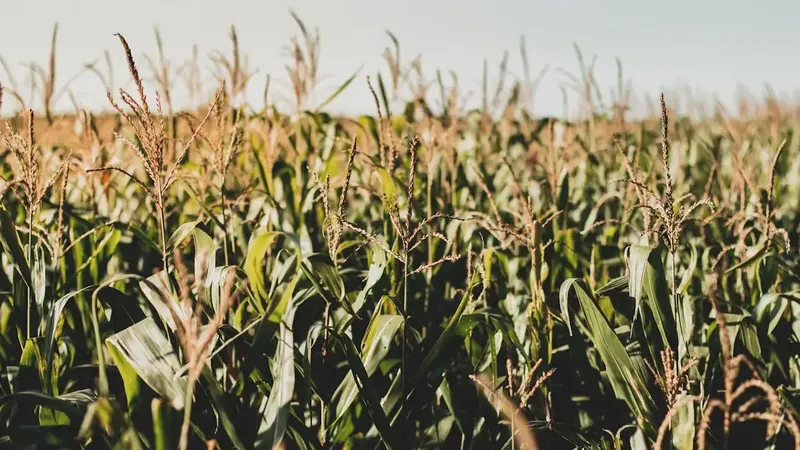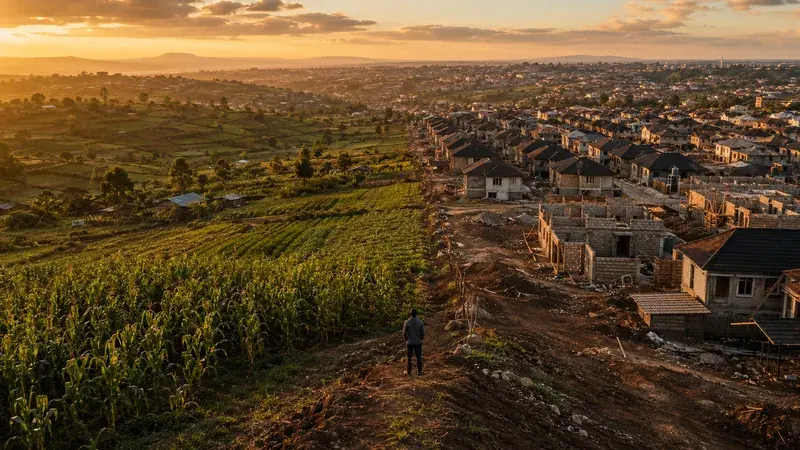
Across Kenya, a quiet but irreversible transformation is underway. The farmlands that once fed generations are disappearing, not to drought or disease, but to concrete. In Kiambu, Nakuru, and Nanyuki, housing estates now stand where maize and wheat once grew. In Nandi and Vihiga, smallholders are squeezing harvests out of plots as tiny as 0.1 acres.
This is not just a land use story. It is a food security crisis in slow motion.
Key takeaways
- Kenya's population is projected to approach 80 million by the mid-2040s, over 20 million more people to feed from a shrinking agricultural base
- Urban sprawl takes the best land first: fertile, well-watered ground near roads and towns
- Average maize yields are stuck around 1.7 tonnes per hectare against 5–6 tonnes achievable with good agronomy
- Land use policy, productivity investment, and post-harvest loss reduction are all still available levers, but the window is five to ten years
A Land Under Pressure
Kenya's population is projected to approach 80 million by the mid-2040s on the UN's latest projections (KNBS's own projection is 70 million by 2045). That is more than 20 million more people than today who will need to be fed, and they will need to be fed from a shrinking, fragmenting agricultural base.
The numbers are sobering:
- In Kenya's high-density farming regions, farm sizes have fragmented to less than 0.1 acres per household in some areas
- Maize yields have stagnated at around 1.7 tonnes per hectare, a fraction of the 5–6 tonnes achievable with good agronomy
- Soil degradation is accelerating as farmers push exhausted plots harder with less investment in soil health
- Meanwhile, urban sprawl is consuming some of the most fertile, well-watered land in the country
What makes this especially alarming is the location of that sprawl. Urban expansion does not follow a logic of agricultural sacrifice zones. It follows road networks, proximity to towns, and land prices. That means it often takes the best land first: the fertile volcanic soils around Nakuru, the well-watered ridges above Kiambu, the highland plains near Nanyuki.
Farmers displaced from this land do not retire from farming. They are pushed to more marginal soils, steeper slopes, drier zones, less forgiving ground. The result is a double loss: fertile land taken out of production, and stressed farmers attempting to compensate on land that punishes effort.
The Yield Problem Is Not Going Away on Its Own
Even setting aside land loss, Kenya's agricultural productivity challenge is significant. Stagnating maize yields reflect a cluster of compounding problems: poor seed access, inconsistent fertiliser use, degraded soils, unreliable rainfall, and limited post-harvest infrastructure that results in significant grain losses before food ever reaches a market.
These are solvable problems, but solving them requires deliberate, sustained investment. And that investment is happening too slowly against a population curve that waits for no one.
The Question That Keeps Coming Back
Every time I look at these numbers, one question surfaces:
How will Kenya feed itself in 10 to 20 years?
Will we import everything? That is not a rhetorical question. It is a strategic risk that deserves an honest national conversation. Food import dependency is a sovereignty issue. It exposes populations to global price shocks, supply chain disruptions, and currency volatility in ways that domestic production, however imperfect, does not.
There Are Choices to Be Made
None of this is inevitable. But it requires deliberate choices today:
On land use: Can urban expansion be channelled toward less fertile areas? There are planning tools that could slow the loss of prime farmland: zoning regulations, land-use incentives, agricultural land protection orders. Other countries have done this. Kenya can too.
On productivity: Stagnant yields are not destiny. Investment in certified seed, soil restoration, extension services, and smallholder financing has demonstrably moved the needle elsewhere on the continent. The question is whether Kenya will make that investment at scale before the demographic pressure becomes a crisis.
On food systems design: Urban development plans rarely integrate food systems thinking. What would it look like to build that in: urban agriculture buffers, local market infrastructure, cold chain logistics designed into new towns from the ground up rather than retrofitted after the fact?
On post-harvest losses: Significant volumes of grain are lost between farm and market due to poor storage, handling, and infrastructure. Reducing those losses is, in effect, increasing production without planting a single additional acre.
The Window Is Narrowing
The urgency here is not abstract. Population projections are not speculative. They are built on current birth rates and demographic momentum. The land that is converted to residential use today will not be easily returned to agriculture. Soil that is degraded over years of overuse takes years to restore.
The decisions made in the next five to ten years about land use policy, agricultural investment, food systems infrastructure, and post-harvest handling will determine whether Kenya feeds itself or becomes structurally dependent on food imports by mid-century.
That is a choice worth making consciously.
Sources
- United Nations, World Population Prospects 2024 (Kenya projections)
- KNBS, 2019 Census Analytical Report on Population Projections, Vol. XVI
- KNBS, National Agriculture Production Report 2025 (maize yields)
- Adopting yield-improving practices to meet maize demand in Sub-Saharan Africa (Nature Comms, 2024)
Put this insight to work. Talk to Kevman & Troyt about your grain operations and post-harvest strategy. Get in touch.

Operations and grain value chain specialist with more than 18 years of experience across East Africa, supporting grain handling, storage, safety, and post-harvest management.
Meet the team